Two Carts, One Italian Afternoon
Two carts, one afternoon
He did not order a serving cart. He ordered a table he can push across a lawn.
The buyer is in Aartrijke, a small town west of Bruges in Belgium. The company does not run restaurants — it builds events: weddings, brand parties, opening receptions, one after another.
So he did not ask how long a cart could be or how much equipment it could hold. He sent a design brief instead: ivory marble, warm solid wood, matte champagne gold, terracotta red. The logo small. No terracotta border on the front. Two carts in the same language — one at 1300 mm, one at 1800 mm.
- Italian, not imported-looking — palette and hardware translated, not approximated.
- Two must read as one set — same materials, same hardware, different proportions.
- Guests serve themselves — eight stainless inserts in the top, plus three wide slots for removable wooden trays.
- Pushed away and packed down — four wheels, folding side shelves; folded, each cart is about 700 mm wide so both fit side by side in a van.
- Cheese must not soften — a 1200 x 550 x 300 mm chilled salad box set into the counter, stainless lined, lid-lifted and never taking counter space.
None of these five is a function. All five are about what it should look like. Function in this category was standardised long ago — it rolls, it holds, it folds. What decides the sale is whether the set looks like the scene the buyer has in mind.
Custom work starts by hearing what it should look like, not by asking what it should do.
Turning “Italian” into four materials
The customer sent a feeling; the workshop needs numbers. The step in between is translating one word into a bill of materials: four finishes, three closing rules, one hardware list.
Only four colours, because the Italian look is not about more — it is about few and exact: ivory as the ground, warm wood as the surface, champagne gold as the line, terracotta as the heavy accent. Add a fifth and the picture falls apart.
Wood runs warm-toned with the grain in one direction — horizontal on the counter, vertical on the shelves — so joints do not fight each other. All metal is matte champagne gold, never bright chrome: one flash of chrome and the whole cart turns into a supermarket shelf.
Every marble-to-wood joint is closed with a 3 mm champagne gold strip. That line is small but it is the boundary between refined and cheap: butt-jointing the two surfaces looks fine from across a room and looks like a two-dollar job up close.
Three closing rules throughout: joints closed with a matched or gold profile rather than butted; exposed screws replaced with matte gold countersunk heads wherever they can be hidden; wheels and handles finished in the same colour as the body, because wheels are touched all day and a wrong colour makes the cart look cheap instantly.
The customer wrote in an email: the logo must be small, it should not take over the picture, and there should be no terracotta border on the front. That reads like taste; on the shop floor it becomes two instructions: the plaque is scaled down to one third of the panel width, and the border is replaced with a marble edge in the same tone.
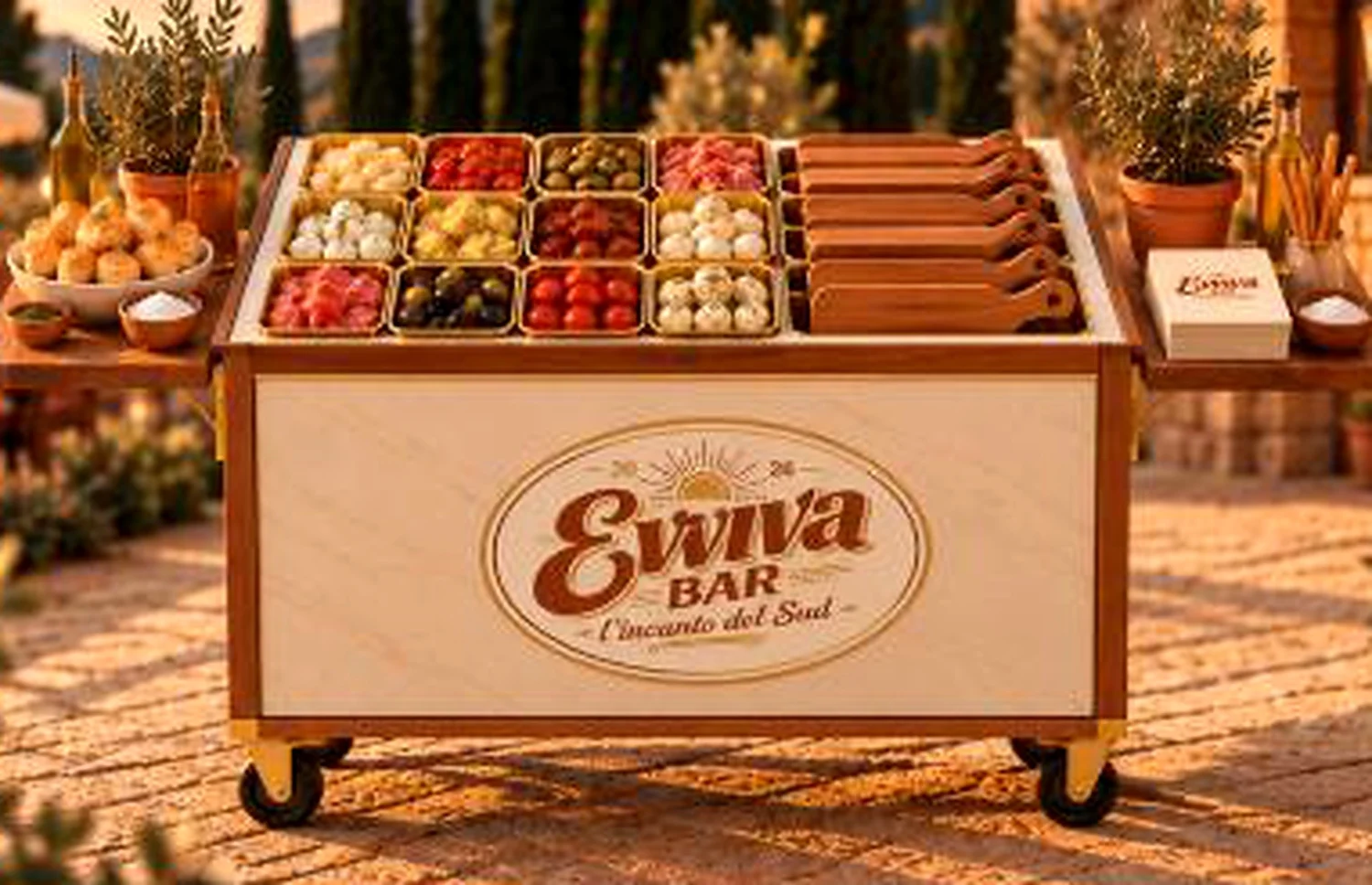
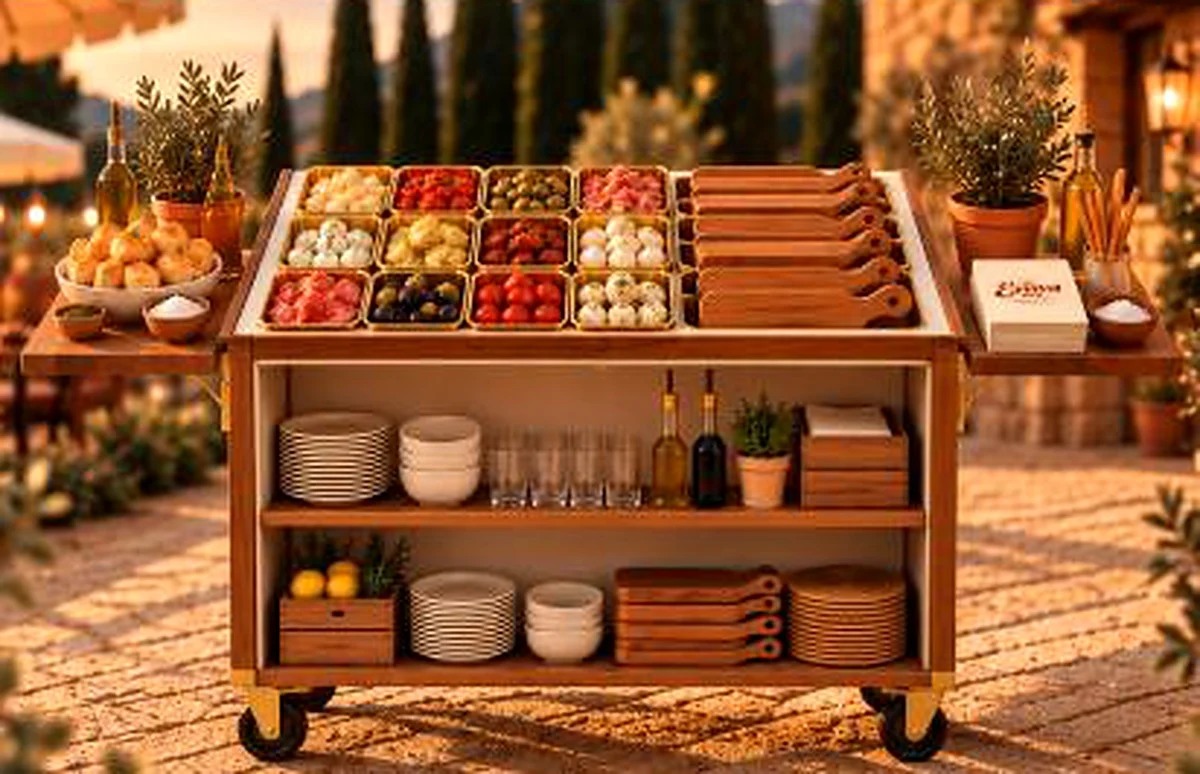
First cart: cheese and charcuterie
1300 x 700 x 1100 mm. That height is a standing height: a guest stands beside the cart and the eye lands on the counter without bending or searching.
Front
- One slab of ivory marble, fine gold veining
- Logo set into the centre
- Gold strip along the top and bottom edge
Top
- Eight stainless inserts on the left
- Cheese, olives and cold cuts separated
- Three wide slots on the right for removable wooden trays
Sides and rear
- One folding wooden shelf each side, 300 mm extra surface
- Two open shelves at the back for plates, bowls, spare trays
- Shelves lift out whole for washing
Chilling
- 1200 x 550 x 300 mm box set into the counter
- Stainless liner, lid access
- No counter space lost
The back is harder than the front. The front is one panel and one plaque; the back has to arrange two shelf levels — plates on top, bowls and trays below — with clear height measured against real objects, because plates stand up and bowls stack flat.
Cheese and cold cuts are what soften first. The chilled box sits flush under the counter, so the person serving lifts a lid instead of walking round to open a cabinet. That is a movement problem, not a refrigeration problem.
Whether a cart works is decided by how far the person serving has to walk around it.
Second cart: wine and glasses
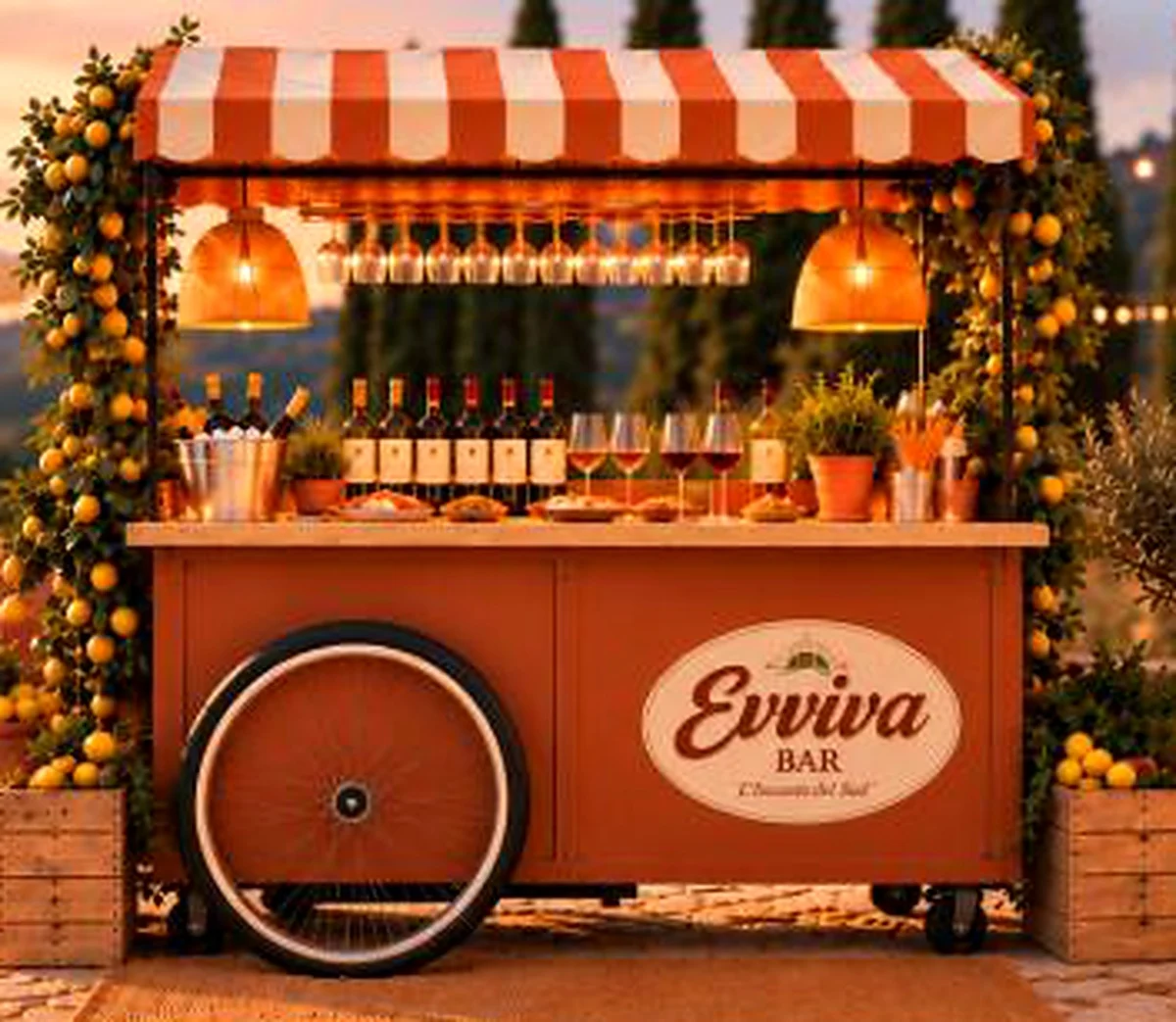
1800 x 850 x 2250 mm — half a metre longer and twice the height of the food cart. Everything above the counter is open: bottles stand on the top, glasses hang from a rack overhead, and a striped awning covers the whole unit.
Body and awning
- Matte terracotta paint
- Ivory and terracotta striped awning
- Two pendant lamps hanging from the awning frame
Glasses and bottles
- Inverted glass rack above the counter
- 400 x 430 x 825 mm wine cabinet set into the rear
- Lower shelf for spare bottles and event material
Wheel
- One large decorative wheel on the front
- A second at the same position at the rear
- Works whichever way it faces the room
Power
- One European socket each side
- Supplies the wine cabinet and pendants
- Plugs into the venue supply
The customer was specific: the large wheel on the front must also be at the same position at the rear, with clearance around it, because a wine cart is often placed back to the room while the host pours from the far side. The cabinet splits the rear into three widths — glasses left, cabinet centre, plates right — sized against the actual objects so a full load never looks crowded.
A front panel is easy. The rear is where the craft shows.
Side by side, it becomes one scene
Alone, each is an attractive cart. Together, they are a scene, which is why both were drawn side by side from the first sheet.
The height difference is deliberate: the food cart is held down at 1100 mm so guests look down onto the food, while the wine cart rises to 2250 mm so that with the awning up it becomes the high point of the venue, visible from across a room. One draws in, the other opens out.
The widths differ too: a 1300 mm cart sits beside a walkway, an 1800 mm cart takes a position of its own. The customer planned the floor himself, keeping both depths under 850 mm so a gap remains for guests to move through.
The palette is shared — the same batch of wood, gold and ivory on both units. Terracotta appears once, on the wine cart only: it needs a heavy tone to hold the scene, while the food cart already has the marble.
A set is a set when removing either piece makes the other look wrong.
From drawing to container
Ordered in June, both carts scheduled together. With no engine, no water and no wiring, a cart builds faster than a food trailer — the time goes into detail: marble cutting, wood samples, hardware colour matching.
- Drawings — one week after payment: dimensions, palette, panel breakdown and hardware positions settled at once.
- Production — 20–25 working days, with progress photos; wood and marble sampled before cutting.
- Assembly check — both units assembled before shipping: shelves folded, chilled box drawn in and out, wine cabinet powered, glasses hung.
- Loading — both carts in one container on timber frames; CI, PL and B/L with the shipment.
The real risk with a pair is not that one looks wrong — it is that the two do not match: a shade off in the wood, half a tone off in the gold, and side by side the difference shows. Material for a single order therefore has to be drawn from one batch, which is a purchasing decision made before cutting, not after.
A brief in words, a set in materials
Send the reference picture, not the specification sheet.
If you are equipping events rather than a fixed shop, tell us what the scene should look like and we will build the material list behind it.